


Page 42 - CLT120720
P. 42
42 ¦ DECEMBER 7, 2020                 CLOSING ARGUMENT

                                      EDITORIAL BOARD

Punitive-Centered Approach to COVID-19
                       Doesn’t Work at Colleges
As new coronavirus infection
        records are being set daily
        and the number of deaths
has exceeded 2,800 per day across
the United States, colleges have
struggled to design and provide
safe educational experiences. Last
month, campus infections passed
a quarter of a million, most occur-
ring in the fall semester, according
to a New York Times survey.
The Times acknowledged that,
although its survey is considered
to be the most comprehensive, it is
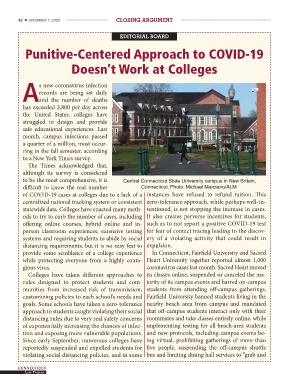
difficult to know the real number     Central Connecticut State University campus in New Britain,

                                      Connecticut. Photo: Michael Marciano/ALM

of COVID-19 cases at colleges due to a lack of a instances have refused to refund tuition. This
centralized national tracking system or consistent zero-tolerance approach, while perhaps well-in-
statewide data. Colleges have enacted many meth- tentioned, is not stopping the increase in cases.
ods to try to curb the number of cases, including It also creates perverse incentives for students,
offering online courses, hybrid online and in- such as to not report a positive COVID-19 test
person classroom experiences, extensive testing for fear of contact tracing leading to the discov-
systems and requiring students to abide by social ery of a violating activity that could result in
distancing requirements, but it is no easy feat to expulsion.
provide some semblance of a college experience In Connecticut, Fairfield University and Sacred
while protecting everyone from a highly conta- Heart University together reported almost 1,000
gious virus.                          coronavirus cases last month. Sacred Heart moved
Colleges have taken different approaches to its classes online, suspended or canceled the ma-
rules designed to protect students and com- jority of its campus events and barred on-campus
munities from increased risk of transmission, students from attending off-campus gatherings.
customizing policies to each school’s needs and Fairfield University banned students living in the
goals. Some schools have taken a zero-tolerance nearby beach area from campus and mandated
approach to students caught violating their social that off-campus students interact only with their
distancing rules due to very real safety concerns roommates and take classes entirely online, while
of exponentially increasing the chances of infec- implementing testing for all beach-area students
tion and exposing more vulnerable populations. and new protocols, including campus events be-
Since early September, numerous colleges have ing virtual, prohibiting gatherings of more than
reportedly suspended and expelled students for five people, suspending the off-campus shuttle
violating social distancing policies, and in some bus and limiting dining hall services to “grab and

CONNECTICUT
     Law Tribune

