


Page 12 - CLT112320
P. 12
12 ¦ NOVEMBER 23, 2020              NEWS

¦ From BAD FAITH on PAGE 11
tual obligation, not prompted
by an honest mistake but by
interested or sinister motive.

See De La Concha of Hart-

ford, Inc. v. Aetna Life Ins. Co.,
269 Conn. 424, 433 (2004). A
bad faith claimant must plead
three essential elements: (1)
plaintiff and defendant were
parties to a contract under
which plaintiff reasonably
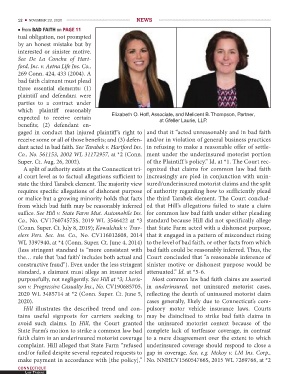
expected to receive certain         Elizabeth O. Hoff, Associate, and Melicent B. Thompson, Partner,
benefits; (2) defendant en-                                     at Gfeller Laurie, LLP.

gaged in conduct that injured plaintiff ’s right to and that it “acted unreasonably and in bad faith
receive some or all of those benefits; and (3) defen- and/or in violation of general business practices
dant acted in bad faith. See Tarabek v. Hartford Ins. in refusing to make a reasonable offer of settle-
Co., No. 561153, 2002 WL 31172957, at *2 (Conn. ment under the underinsured motorist portion
Super. Ct. Aug. 26, 2002).          of the Plaintiff ’s policy.” Id. at *1. The Court rec-
A split of authority exists at the Connecticut tri- ognized that claims for common law bad faith
al court level as to factual allegations sufficient to increasingly are pled in conjunction with unin-
state the third Tarabek element. The majority view sured/underinsured motorist claims and the split
requires specific allegations of dishonest purpose of authority regarding how to sufficiently plead
or malice but a growing minority holds that facts the third Tarabek element. The Court conclud-
from which bad faith may be reasonably inferred ed that Hill’s allegations failed to state a claim
suffice. See Hill v. State Farm Mut. Automobile Ins. for common law bad faith under either pleading
Co., No. CV176074575S, 2019 WL 3546422 at *3 standard because Hill did not specifically allege
(Conn. Super. Ct. July 8, 2019); Kowalchuk v. Trav- that State Farm acted with a dishonest purpose,
elers Pers. Sec. Ins. Co., No. CV116012608, 2014 that it engaged in a pattern of misconduct rising
WL 3397940, at *4 (Conn. Super. Ct. June 4, 2014) to the level of bad faith, or other facts from which
(less stringent standard is “more consistent with bad faith could be reasonably inferred. Thus, the
the… rule that ‘bad faith’ includes both actual and Court concluded that “a reasonable inference of
constructive fraud”). Even under the less stringent sinister motive or dishonest purpose would be
standard, a claimant must allege an insurer acted attenuated.” Id. at *5-6.
purposefully, not negligently. See Hill at *3; Lheris- Most common law bad faith claims are asserted
son v. Progressive Casualty Ins., No. CV190685705, in underinsured, not uninsured motorist cases,
2020 WL 3485714 at *2 (Conn. Super. Ct. June 5, reflecting the dearth of uninsured motorist claim
2020).                              cases generally, likely due to Connecticut’s com-
  Hill illustrates the described trend and con- pulsory motor vehicle insurance laws. Courts
tains useful signposts for carriers seeking to may be disinclined to strike bad faith claims in
avoid such claims. In Hill, the Court granted the uninsured motorist context because of the
State Farm’s motion to strike a common law bad complete lack of tortfeasor coverage, in contrast
faith claim in an underinsured motorist coverage to a mere disagreement over the extent to which
complaint. Hill alleged that State Farm “refused underinsured coverage should respond to close a
and/or failed despite several repeated requests to gap in coverage. See, e.g. Mckoy v. LM Ins. Corp.,
make payment in accordance with [the policy],” No. NNHCV156054766S, 2015 WL 7269766, at *2

CONNECTICUT
     Law Tribune

