


Page 5 - CLT102620
P. 5
NEWS                                        OCTOBER 26, 2020 ¦ 5

New Data on Racial Disparities in Lawyer
Hiring Is ‘Wake-Up Call’ for the Profession

                      By Karen Sloan

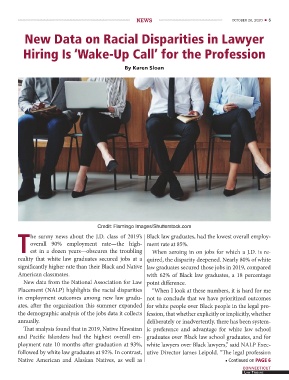
                                                Credit: Flamingo Images/Shutterstock.com

The sunny news about the J.D. class of 2019’s Black law graduates, had the lowest overall employ-
      overall 90% employment rate—the high- ment rate at 85%.
      est in a dozen years—obscures the troubling When zeroing in on jobs for which a J.D. is re-
reality that white law graduates secured jobs at a quired, the disparity deepened. Nearly 80% of white
significantly higher rate than their Black and Native law graduates secured those jobs in 2019, compared
American classmates.                             with 62% of Black law graduates, a 18 percentage
New data from the National Association for Law point difference.
Placement (NALP) highlights the racial disparities “When I look at these numbers, it is hard for me
in employment outcomes among new law gradu- not to conclude that we have prioritized outcomes
ates, after the organization this summer expanded for white people over Black people in the legal pro-
the demographic analysis of the jobs data it collects fession, that whether explicitly or implicitly, whether
annually.                                        deliberately or inadvertently, there has been system-
That analysis found that in 2019, Native Hawaiian ic preference and advantage for white law school
and Pacific Islanders had the highest overall em- graduates over Black law school graduates, and for
ployment rate 10 months after graduation at 93%, white lawyers over Black lawyers,” said NALP Exec-
followed by white law graduates at 92%. In contrast, utive Director James Leipold. “The legal profession
Native American and Alaskan Natives, as well as
                                                                  ¦ Continued on PAGE 6

                                                                  CONNECTICUT
                                                                   Law Tribune

