


Page 28 - CLT061520
P. 28
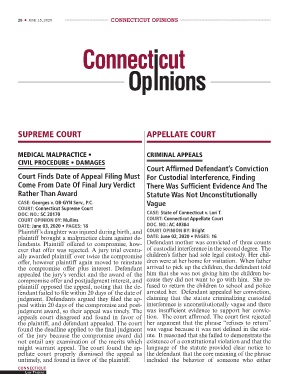
28 ¦ JUNE 15, 2020                   CONNECTICUT OPINIONS

SUPREME COURT                                       APPELLATE COURT

MEDICAL MALPRACTICE •                               CRIMINAL APPEALS

CIVIL PROCEDURE • DAMAGES                           Court Affirmed Defendant’s Conviction

Court Finds Date of Appeal Filing Must For Custodial Interference, Finding
Come From Date Of Final Jury Verdict There Was Sufficient Evidence And The
Rather Than Award                                   Statute Was Not Unconstitutionally

CASE: Georges v. OB-GYN Serv., P.C.                 Vague
COURT: Connecticut Supreme Court
DOC. NO.: SC 20170                                  CASE: State of Connecticut v. Lori T.
COURT OPINION BY: Mullins                           COURT: Connecticut Appellate Court
                                                    DOC. NO.: AC 40384
DATE: June 03, 2020 • PAGES: 18
Plaintiff’s daughter was injured during birth, and COURT OPINION BY: Bright
plaintiff brought a malpractice claim against de-   DATE: June 02, 2020 • PAGES: 16
fendants. Plaintiff offered to compromise, how-
ever that offer was rejected. A jury trial eventu-  Defendant mother was convicted of three counts
ally awarded plaintiff over twice the compromise    of custodial interference in the second degree. The
offer, however plaintiff again moved to reinstate   children’s father had sole legal custody. Her chil-
the compromise offer plus interest. Defendant       dren were at her home for visitation. When father
                                                    arrived to pick up the children, the defendant told
                                                    him that she was not giving him the children be-
appealed the jury’s verdict and the award of the    cause they did not want to go with him. She re-
compromise offer and postjudgment interest, and
plaintiff opposed the appeal, noting that the de- fused to return the children to school and police
fendant failed to file within 20 days of the date of arrested her. Defendant appealed her conviction,
judgment. Defendants argued they filed the ap- claiming that the statute criminalizing custodial
peal within 20 days of the compromise and post- interference is unconstitutionally vague and there
judgment award, so their appeal was timely. The was insufficient evidence to support her convic-
appeals court disagreed and found in favor of tion. The court affirmed. The court first rejected
the plaintiff, and defendant appealed. The court her argument that the phrase “refuses to return”
found the deadline applied to the final judgment was vague because it was not defined in the stat-
of the jury because the compromise award did ute. It reasoned that she failed to demonstrate the
not entail any examination of the merits which existence of a constitutional violation and that the
might warrant appeal. The court found the ap- language of the statute provided clear notice to
pellate court properly dismissed the appeal as the defendant that the core meaning of the phrase
untimely, and found in favor of the plaintiff.      included the behavior of someone who either

CONNECTICUT
     Law Tribune

