


Page 19 - CLT032320
P. 19
NEWS                 MARCH 23, 2020 ¦ 19

When Bankruptcy Can Save a Property
From Foreclosure, Timing is Everything

                                   By Irve J. Goldman

Bankruptcy and foreclosure often keep the same
       company, as a mortgagor whose property is
       under foreclosure will frequently resort to
bankruptcy at some point in the foreclosure process
to attempt to save it. At what point bankruptcy relief
must be sought for that purpose can depend upon
applicable state law, and the analysis can be tricky.
What follows is a navigation of this somewhat tech-
nical issue for a Connecticut mortgage foreclosure,
with some historical perspective.
In Connecticut, there are two methods of foreclos-
ing a mortgage on real property: strict foreclosure
and foreclosure by sale. Ocwen Federal Bank, FSB v.
Charles, 95 Conn. App. 315, 323 (2006). See gener-
ally C.G.S. §49-24. Foreclosure simply means to “cut
off the equity of redemption, the equitable owner’s
right to redeem the property,” id., which can be done
either “by sale or strict foreclosure.” Mortgage Elec-
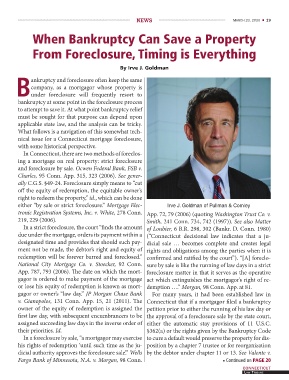
                                                        Irve J. Goldman of Pullman & Comley

tronic Registration Systems, Inc. v. White, 278 Conn.   App. 72, 79 (2006) (quoting Washington Trust Co. v.
219, 229 (2006).                                        Smith, 241 Conn. 734, 742 (1997)). See also Matter
                                                        of Loubier, 6 B.R. 298, 302 (Bankr. D. Conn. 1980)
  In a strict foreclosure, the court “finds the amount  (“Connecticut decisional law indicates that a ju-
due under the mortgage, orders its payment within a
designated time and provides that should such pay- dicial sale … becomes complete and creates legal
ment not be made, the debtor’s right and equity of rights and obligations among the parties when it is
redemption will be forever barred and foreclosed.” confirmed and ratified by the court”). “[A] foreclo-
National City Mortgage Co. v. Stoecker, 92 Conn. sure by sale is like the running of law days in a strict
App. 787, 793 (2006). The date on which the mort- foreclosure matter in that it serves as the operative
gagor is ordered to make payment of the mortgage act which extinguishes the mortgagor’s right of re-
or lose his equity of redemption is known as mort- demption ….” Morgan, 98 Conn. App. at 81.
gagor or owner’s “law day.” JP Morgan Chase Bank For many years, it had been established law in
v. Gianopolos, 131 Conn. App. 15, 21 (2011). The Connecticut that if a mortgagor filed a bankruptcy
owner of the equity of redemption is assigned the petition prior to either the running of his law day or
first law day, with subsequent encumbrancers to be the approval of a foreclosure sale by the state court,
assigned succeeding law days in the inverse order of either the automatic stay provisions of 11 U.S.C.
their priorities. Id.                                   §362(a) or the rights given by the Bankruptcy Code
In a foreclosure by sale, “a mortgagor may exercise to cure a default would preserve the property for dis-
his rights of redemption ‘until such time as the ju- position by a chapter 7 trustee or for reorganization
dicial authority approves the foreclosure sale’.” Wells by the debtor under chapter 11 or 13. See Valente v.
Fargo Bank of Minnesota, N.A. v. Morgan, 98 Conn.
                                                        ¦ Continued on PAGE 20

                                                        CONNECTICUT
                                                         Law Tribune

