


Page 26 - CLT010421
P. 26
26 ¦ JANUARY 4, 2021                       NEWS

¦ From SCOTUS’ on PAGE 25                      In 1927, the court recognized Congress’ power to
The court’s decision represents the first substan- “secure needed information” as part of its legisla-
tive Supreme Court decision on Congressional in- tive function in McGrain v. Daugherty, a case aris-
vestigations in 45 years, consistent with the general ing from the Teapot Dome scandal. This “power of
infrequency of past decisions on the subject. The inquiry—with process to enforce it—is an essential
relative dearth of jurisprudence in this realm re- and appropriate auxiliary to the legislative function,”
flects the fact that disputes between Congress and the court declared. Thirty years later, in Watkins v.
the executive branch over legislative subpoenas re- United States, the court described this power as “in-
quiring judicial intervention are rare because the dispensable,” and “as penetrating and far-reaching
two political branches traditionally resolve the dis- as the potential power to enact and appropriate un-
putes directly between themselves.             der the Constitution,” in Barenblatt v. United States,
Questions about the permissibility and scope a pair of cases stemming from hearings held by the
of congressional investigations into the executive House Committee on Un-American Activities.
branch are as old as the Republic itself. In 1792, the The Supreme Court issued the  Mazars  ruling
House of Representatives investigated a disastrous against this historical backdrop, but court  classi-
military expedition led by Gener-                                    fied the question presented as a
al Arthur St. Clair that resulted in                                 matter of first impression because
hundreds of American casualties.                                     it had “never addressed a con-
The House created a special inves-                                   gressional subpoena for the Presi-
tigative committee, authorizing                                      dent’s information.”
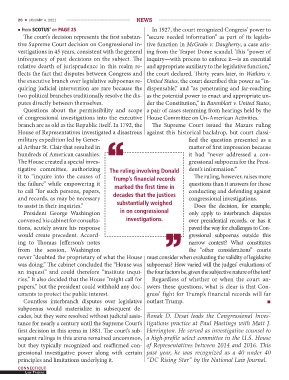
it to “inquire into the causes of       The ruling involving Donald    The ruling, however, raises more
the failure” while empowering it         Trump’s financial records
to call “for such persons, papers,        marked the first time in   questions than it answers for those
and records, as may be necessary         decades that the justices   conducting and defending against
to assist in their inquiries.”             substantially weighed     congressional investigations.
                                             in on congressional
  President George Washington                   investigations.        Does the decision, for example,
convened his cabinet for consulta-                                   only apply to interbranch disputes
tions, acutely aware his response                                    over presidential records, or has it
                                                                     paved the way for challenges to Con-
would create precedent. Accord-                                      gressional subpoenas outside this
ing to Thomas Jefferson’s notes                                      narrow context? What constitutes
from the session, Washington                                         the “other considerations” courts
never “doubted the proprietary of what the House must consider when evaluating the validity of legislative
was doing.” The cabinet concluded the “House was subpoenas? How varied will the judges’ evaluations of
an inquest” and could therefore “institute inqui- the four factors be, given the subjective nature of the test?
ries.” It also decided that the House “might call for Regardless of whether or when the court an-
papers,” but the president could withhold any doc- swers these questions, what is clear is that Con-
uments to protect the public interest.         gress’ fight for Trump’s financial records will far
Countless interbranch disputes over legislative outlast Trump.
subpoenas would materialize in subsequent de-                                                  ¦

cades, but they were resolved without judicial assis- Ronak D. Desai leads the Congressional Inves-
tance for nearly a century until the Supreme Court’s tigations practice at Paul Hastings with Matt J.
first decision in this arena in 1881. The court’s sub- Herrington. He served as investigative counsel to
sequent rulings in this arena remained uncommon, a high-profile select committee in the U.S. House
but they typically recognized and reaffirmed con- of Representatives between 2014 and 2016. This
gressional investigative power along with certain past year, he was recognized as a 40 under 40
principles and limitations underlying it.      “DC Rising Star” by the National Law Journal.

CONNECTICUT
     Law Tribune

